
Election 2026: Once marquee matchup for U.S. Senate losing spotlight
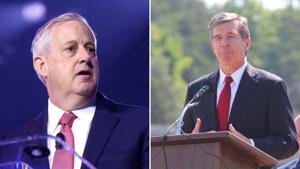
Democrat Roy Cooper wants to “make stuff cost less” and Republican Michael Whatley is pushing to keep his party’s majority in order to enact the agenda of second-term Republican President Donald Trump.
North Carolina’s seat in the U.S. Senate, held by second-term Republican Sen. Thom Tillis, has been the state’s headline act for the 2026 midterms since each formally declared to run in July 2025. Tillis a month earlier said he would escape the Beltway gridlock and not seek reelection, having supported Trump better than 9 in 10 times during his tenure amid some very public spats on routes to outcomes.
Cooper has been a frontrunner and would be a trend-breaker if victorious. Once pegged to set Senate campaign spending records, the dynamics of the race may wind up allowing their respective parties nationally to spend elsewhere.
Voting started in a 61-day window, the nation’s longest, when requested absentee ballots were mailed out Sept. 4. In-person early voting is Oct. 15-31, and Election Day is Nov. 3.
This U.S. Senate seat has long been viewed as a major player nationally in the quest for a majority in the chamber. Republicans have 53 seats today. Thirty-five seats are on the ballot, two of which are special elections.
In no particular order, Ohio, Michigan, Georgia, Maine, Iowa, New Hampshire, Alaska, Texas and Montana have been considered the other top battlegrounds. Democrats’ momentum has brought Kansas into the picture and changed the outlook on both North Carolina and Georgia, while Republican momentum has changed the outlook in Montana.
Cooper and Whatley have campaigned 14 months to reach this final one, yet many from Murphy to Manteo can still recall the “Hands” ad spot that played in 1990 one week before Republican Jesse Helms was reelected over Harvey Gantt.
Cooper said he “can bring consensus building.”
“I was a Democratic governor with a Republican legislature for eight years, and it’s going to be critical to have someone who will reach across the aisle,” he said in a local television interview while campaigning Friday in Wilmington.
Cooper’s push on prices includes groceries, healthcare, energy and utilities, childcare and housing. He pitches himself as moderate and bipartisan, yet his two terms as governor against Republican majorities in the General Assembly were fraught with litigation and he signed just one of four two-year budgets. He wielded authority, or tried, with a record 328 executive orders and a record 104 vetoes.
Cooper has 38 years in office: eight as governor, 16 as attorney general, 10 years in the state Senate and four years in the state House of Representatives. Whatley is making his first run at elected office, having previously helped many in his tenures as chairman of the North Carolina Republican Party, then as the Trump-picked chairman of the Republican National Committee.
Whatley’s campaign has hammered away at Cooper on public safety, saying he wants to make North Carolina safe again. He’s also stumping on the fight against illegal immigration, an America first economy, protecting conservative values, and bringing hurricane recovery relief to the mountains.
“I want every North Carolina family to make more money, to keep more money,” Whatley, with Trump behind him, told those gathered in Gastonia on Sept. 16. “I want every community to be safe and secure. I want us to have the strongest Army, Navy, Air Force, Marines and Coast Guard in the entire world.”
Whatley said he answered the call 11 years ago from Trump because the businessman considered a longshot in a crowded 17-candidate primary said he “was going to make America great again.”
“And it wasn’t just a pithy campaign slogan that he borrowed from President Reagan,” Whatley said. “It was a plan to rebuild our economy, to restore our borders, and keep our communities safe, and make sure that America is the strongest, most respected nation on the face of the earth.”
Whatley is inextricably tied to Trump, both from his RNC chairmanship and being his choice for this race. While Senate seats trend heavily to Republicans in the state, the president’s disapproval rating is pulling hard – a minus-14 (55% disapprove, 41% approve) in Wednesday’s release from a sampling Sept. 4-15 by Catawba College’s Center for North Carolina Politics & Public Service in conjunction with YouGov.
The same poll said independents, the state’s largest voting bloc at more than 40%, are choosing Cooper 48%-28% and the former governor has a 60% edge with Blacks and 18% edge with women. An AARP poll of Sept. 17-20 released earlier this week said Cooper has a 66% edge with Blacks and a 39% edge for ages 18-49.
Whatley turned 57 on Thursday, Cooper 69 on June 13.
Cooper, in Wilmington standing with healthcare workers and teachers, said voters have a choice.
“It’s pretty clear that Michael Whatley is going to do and say whatever this president tells him to do and say, regardless of whether it’s good for the people of North Carolina or this country,” Cooper said. “And I’m going to be a strong independent senator.
“Look, I’ll work with this president when I can, but I’m going to stand up to him when I need to.”
Cooper’s bid to succeed Tillis would be trend-breaking if successful. Tillis, Richard Burr and Ted Budd have made Republicans 5-for-5 since Democrat Kay Hagan won election to the U.S. Senate in 2008. And Democrats haven’t taken a midterm Senate seat in the state since John Edwards in 1998.
Republicans in statewide races for this decade – 2020, 2022 and 2024 – are 32-10 against Democrats, a party with significantly declining voter registrations for more than 20 consecutive years, according to State Board of Elections data analyzed by The Center Square.



Mostly Clear
