
Marshall Board Adopts $17.9 Million FY2027 Budget With $915,000 Deficit
Marshall C.U.S.D. C-2 Board of Education | September 10, 2026
Article Summary: The Marshall C.U.S.D. C-2 Board of Education unanimously adopted a fiscal year 2027 budget on Sept. 10, 2026, projecting $17,028,087.93 in revenue against $17,943,334.85 in expenditures — a planned shortfall of $915,246.92, most of it in the Education Fund. No member of the public spoke at the budget hearing that preceded the vote.
FY2027 Budget Key Points:
- Total projected revenue of $17,028,087.93 against total projected expenditures of $17,943,334.85, a difference of -$915,246.92 across all nine funds.
- The Education Fund accounts for $560,033.05 of the gap, and the Capital Projects Fund for $477,319.00.
- Superintendent Ross told the board the district intends to cover the Education Fund deficit with funds on hand and return the budget to balance over a two-year period.
- Adopted 7-0 on a roll call, with no questions from the public during the hearing.
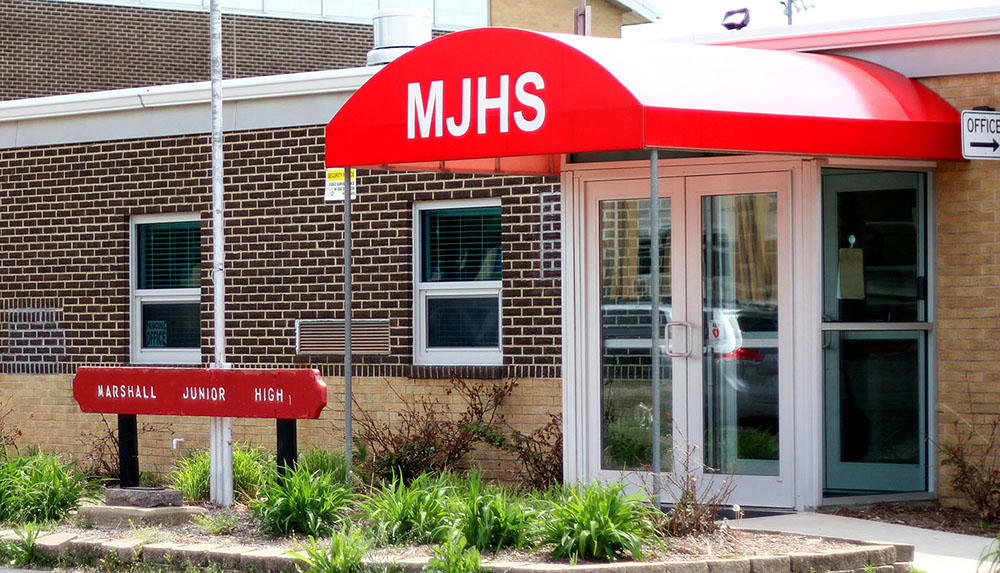
MARSHALL — The Marshall C.U.S.D. C-2 Board of Education on Thursday, Sept. 10, 2026, adopted a fiscal year 2027 budget that anticipates spending roughly $915,000 more than it takes in, after a public hearing in the Marshall Junior High School library at which no resident rose to ask a question.
Board member Macke, who presided over the meeting, opened the hearing. Superintendent Ross began by reading the district’s beginning balance in each of its nine funds: $10,086,473 in the Education Fund; $990,005 in Operations & Maintenance; $144,205 in the Debt Service Fund; $584,973 in the Transportation Fund; $158,999 in the IMRF & Social Security Fund; $674,837 in Capital Projects; $512,904 in Working Cash; $155,351 in Tort; and $340,139 in Fire Prevention & Safety.
He then walked the board through projected revenues and expenditures fund by fund. On the revenue side, the budget anticipates $13,296,787.93 in the Education Fund, $1,091,747 in Operations & Maintenance, $755,084 in Debt Service, $817,414 in Transportation, $442,373 in IMRF & Social Security, $124,125 in Capital Projects, $119,841 in Working Cash, $258,375 in Tort and $122,341 in Fire Prevention & Safety, for a total of $17,028,087.93.
Budgeted expenditures run higher in six of the nine funds: $13,856,820.98 in Education, $1,127,672.08 in Operations & Maintenance, $736,534.91 in Debt Service, $816,771.14 in Transportation, $474,968.74 in IMRF & Social Security, $601,444 in Capital Projects, nothing in Working Cash, $278,123 in Tort and $51,000 in Fire Prevention & Safety — $17,943,334.85 in all.
Three funds show a surplus on paper: Fire Prevention & Safety at $71,341, Debt Service at $18,549.09 and Transportation at $642.86, the narrowest margin in the budget. Working Cash shows $119,841 in revenue against no budgeted spending.
Education Fund Carries Most of the Gap
The single largest component of the shortfall sits in the Education Fund, where budgeted spending exceeds projected revenue by $560,033.05. Ross described the Education Fund as running a deficit by design, with the goal of using funds on hand to cover it and bring the budget back into balance over a two-year span.
He attributed the pressure to several cost lines that he said had risen drastically over the past five years: salary and wage costs, special education costs, fuel and maintenance repairs.
The board also had the numbers in front of it in a condensed form, a “Big 4” view covering only the Education, Operations & Maintenance, Transportation and Working Cash funds. On that basis, revenue totals $15,325,789.93 against $15,801,264.20 in expenditures, a difference of $475,474.27.
Capital Projects Fund Near Exhaustion
The second-largest piece of the deficit, $477,319, falls in Capital Projects, and Ross explained why.
The district’s boiler replacement had been moved into Capital Projects, he said, because work already completed cannot be included in the 10 Year HLS plan. With the resource building phase 2 renovation, the boiler replacement and the Forsyth Center upgrades all charged to Capital Projects, Ross told the board that fund will be close to spent at the end of the fiscal year.
He flagged a further cost that has not yet landed anywhere in the budget. The 10 Year HLS Survey may include heavy costs to replace doors that the architect believes are not up to code, Ross said. That question is under review, he added, because most HLS issues in older buildings are allowed to be grandfathered in under the code in force when the building, or the relevant portion of it, was constructed. There are exceptions to that principle, and Ross said the door question might fall under one of them.
Neither the architect nor a cost estimate for the door work was named in the record of the meeting.
The Vote
The agenda set the hearing out in five steps — opening, review of the budget, comments or questions from the public or board, reading of written comments or questions, and closing. The minutes record that no public questions were offered.
Board member Hendrix moved to adopt the FY2027 budget as presented, seconded by board member Gard. On a roll call, all seven members voted aye: Morecraft, Lycan, Crews, Maurer, Gard, Hendrix and Macke.
The board sat with a full complement of seven. Also present were Superintendent Ross and administrators Ritchey, Lake, Bagby, Keown and Bridgewater.


Partly Sunny
